
Why Maritime AI Needs Its Own Agent Harness
Why maritime operations need more than a general-purpose AI agent
Consider a request that sounds simple:
Every weekday at 7 AM, review my fleet, identify the vessels with the highest commercial risk, and tell me what needs attention.
A capable language model can understand the instruction. It can reason about risk, call tools, compare information, and write a useful summary. But before that reasoning can become a dependable operational workflow, the system has to answer a much longer list of questions.
What does “my fleet” mean for this user? Which vessels are they authorized to see? Which voyage and reports are current? Which data sources are authoritative? What happens when a vessel has not reported? Should the analysis continue if one tool fails? Where should the result appear? Can the user inspect the evidence later? Will the same process run reliably tomorrow?
Those are not language-model questions. They are harness questions.
That distinction is why we built AanyaX as a custom agent harness for maritime operations. The model provides intelligence. The harness gives that intelligence the context, tools, boundaries, execution environment, and review loop required to do useful work inside BOSS.
What General-Purpose Agent Harnesses Taught Us
General-purpose agent harnesses, including products such as Claude Code and Codex, demonstrated something important: a strong model becomes far more capable when it is placed inside a well-designed environment.
A general-purpose harness is designed for breadth. It can work across files, terminals, APIs, web services, and custom tools, allowing people to assemble agents for many different kinds of work. That flexibility is its strength. It also means the domain context, permissions, operating rules, and workflow lifecycle usually have to be configured for the task at hand.
We took the same architectural lesson seriously. AanyaX applies it to a narrower problem: recurring work inside maritime operations.
Instead of assembling the environment for every maritime workflow, AanyaX begins with the environment BOSS already understands: the authenticated user, client and vessel scope, active voyage context, validated reports, monitoring signals, checklists, commercial constraints, and prior run history. Its tools are approved BOSS capabilities, and its outputs are designed for operational work—a fleet brief, ranked risk list, anomaly alert, live dashboard, or supporting evidence for a decision.
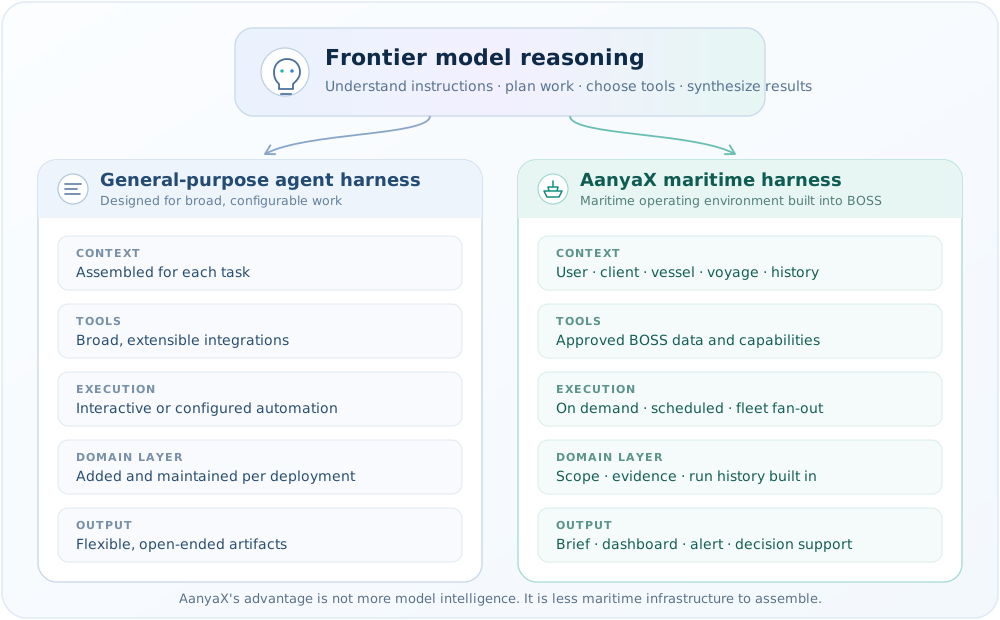
This is not an argument that general-purpose agents are limited, or that AanyaX is better suited to every task. A general-purpose harness can be extended with the same tools and connections. The difference is how much maritime infrastructure a team must assemble and maintain before the agent can do dependable operational work. With AanyaX, that domain layer is the product.
A Prompt Does Not Define an Operating Environment
It is tempting to treat domain specialization as a prompting problem. Put enough maritime instructions into a system prompt, connect some data, and ask the model to behave like a fleet analyst.
Prompts matter, but they cannot carry the full responsibility of an operational system.
A prompt can tell an agent to inspect a voyage. It cannot by itself guarantee that the agent received the correct voyage for the correct vessel under the correct user’s access scope. A prompt can request supporting evidence. It cannot create durable provenance for every tool call and every scheduled run. A prompt can say “run every morning.” It cannot provide scheduling, retries, partial-failure handling, run history, and a place for the result to be reviewed.
The harness turns these requirements from suggestions in natural language into properties of the system.
Maritime Tools, Not Raw Data Access
Useful maritime analysis rarely comes from placing a large database in front of a model and asking it to find something interesting.
Operational data has definitions, relationships, validation rules, and time context. Noon reports, voyage legs, weather exposure, consumption, commercial warranties, checklist status, and monitoring signals each need to be interpreted through the workflows that produced them.
AanyaX exposes approved BOSS capabilities as tools the agent can reason over. This gives the model useful actions while preserving the logic and access controls of the underlying platform. It also makes the agent’s work easier to inspect: the system can record which tool was used, with what scope, and what evidence contributed to the result.
The goal is not to give an agent access to everything. It is to give it the right capability for the job.
Operational Work Continues After the Chat Closes
General chat is naturally interactive: a user asks a question and waits for an answer. Much of maritime work follows a different rhythm.
Fleet reviews happen each morning. Reports arrive vessel by vessel. Commercial checks repeat weekly. Performance and compliance workflows continue whether or not someone has opened a chat window.
That requires an execution layer that can run an agent on demand or on a schedule, preserve its configuration, fan work out across permitted vessels, gather the results back into a fleet-level view, and keep a record of each run. It also has to handle the ordinary imperfections of operational data. One missing report or unavailable tool should be visible and handled explicitly, not quietly converted into a confident conclusion.
For AanyaX, an agent is therefore not just a conversation. It is a reusable operational workflow with inputs, tools, timing, scope, outputs, and history.
The Durable Layer Around Fast-Moving Models
Models will continue to improve. The strongest model for a workflow today may not be the strongest one tomorrow. Costs, speed, context limits, and tool-use capabilities will continue to change.
The maritime operating environment is more durable. User identity, vessel scope, BOSS integrations, approved tools, workflow definitions, run history, and evidence requirements still need to remain consistent as the intelligence underneath evolves.
That separation is deliberate. The value of AanyaX is not tied only to what one model can do at one point in time. It comes from combining capable models with a maritime system that knows where they are operating, what they may access, how recurring work should run, and how people can review the result.
Custom Does Not Mean Building Everything From Scratch
Building a custom harness does not mean replacing the advances happening in foundation models or general-purpose agents. We benefit from those advances. Better reasoning, longer context, stronger tool use, and more reliable instruction following all expand what can be built on top.
The custom work is the domain layer: translating those capabilities into safe, repeatable, and useful maritime operations.
General-purpose harnesses provide a flexible environment for assembling many kinds of agents. AanyaX provides an environment already grounded in BOSS and shaped around maritime workflows.
The model was ready to reason. The missing piece was everything required to make that reasoning operational.