
From Qaira to AanyaX: How Maritime AI Moved From Chat to Agents
The journey from searchable BOSS to repeatable maritime workflows
Every generation of maritime software changes what teams can ask from their systems.
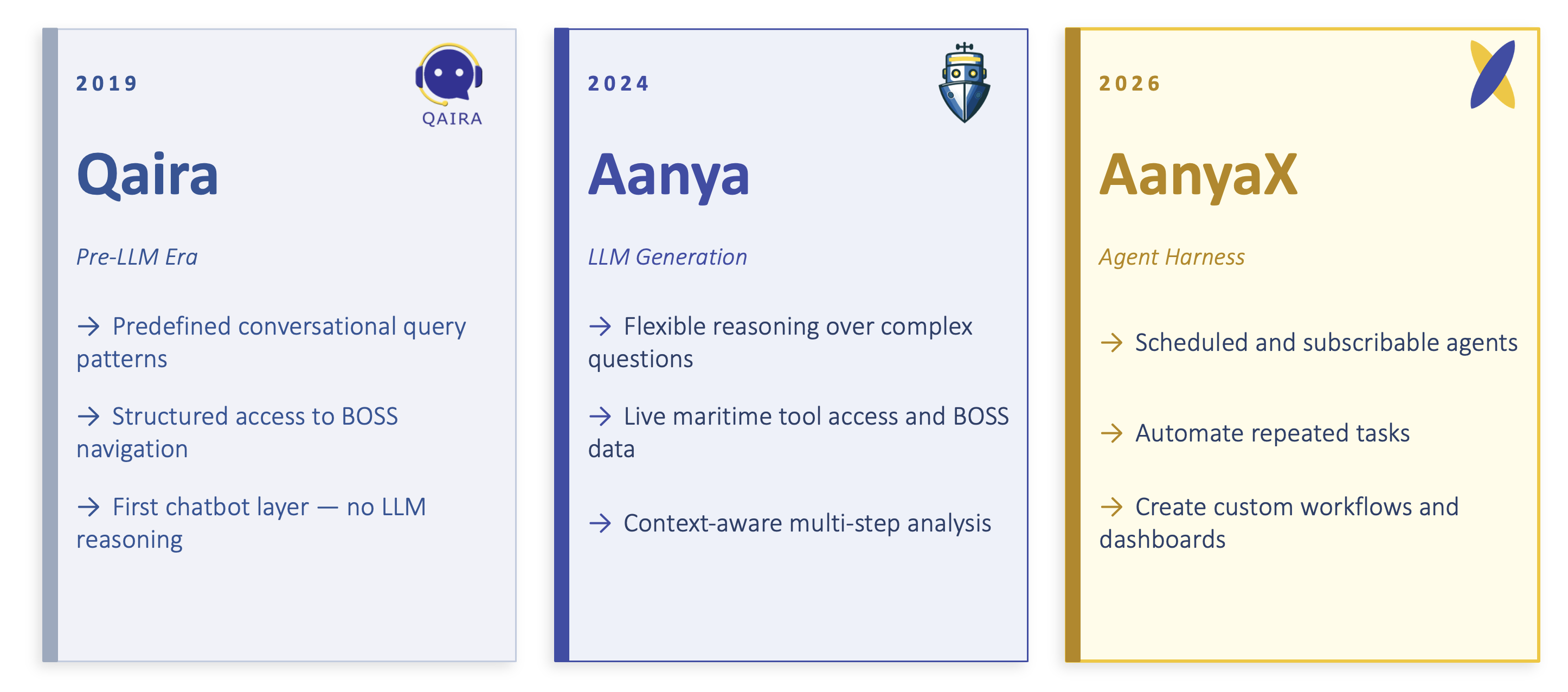
At first, the challenge was access. BOSS contained deep operational knowledge, but teams still needed a faster way to reach the right answer without navigating through every screen, report, and module. Then the challenge became flexibility. Once large language models could reason, use tools, and support follow-up questions, maritime AI could move beyond predefined answers. Now the challenge is repeatability. The most useful work is often not a single question, but a workflow that has to run again and again across vessels, reports, and operating conditions.
That is the journey from Qaira to Aanya to AanyaX.
Qaira: Making BOSS Searchable
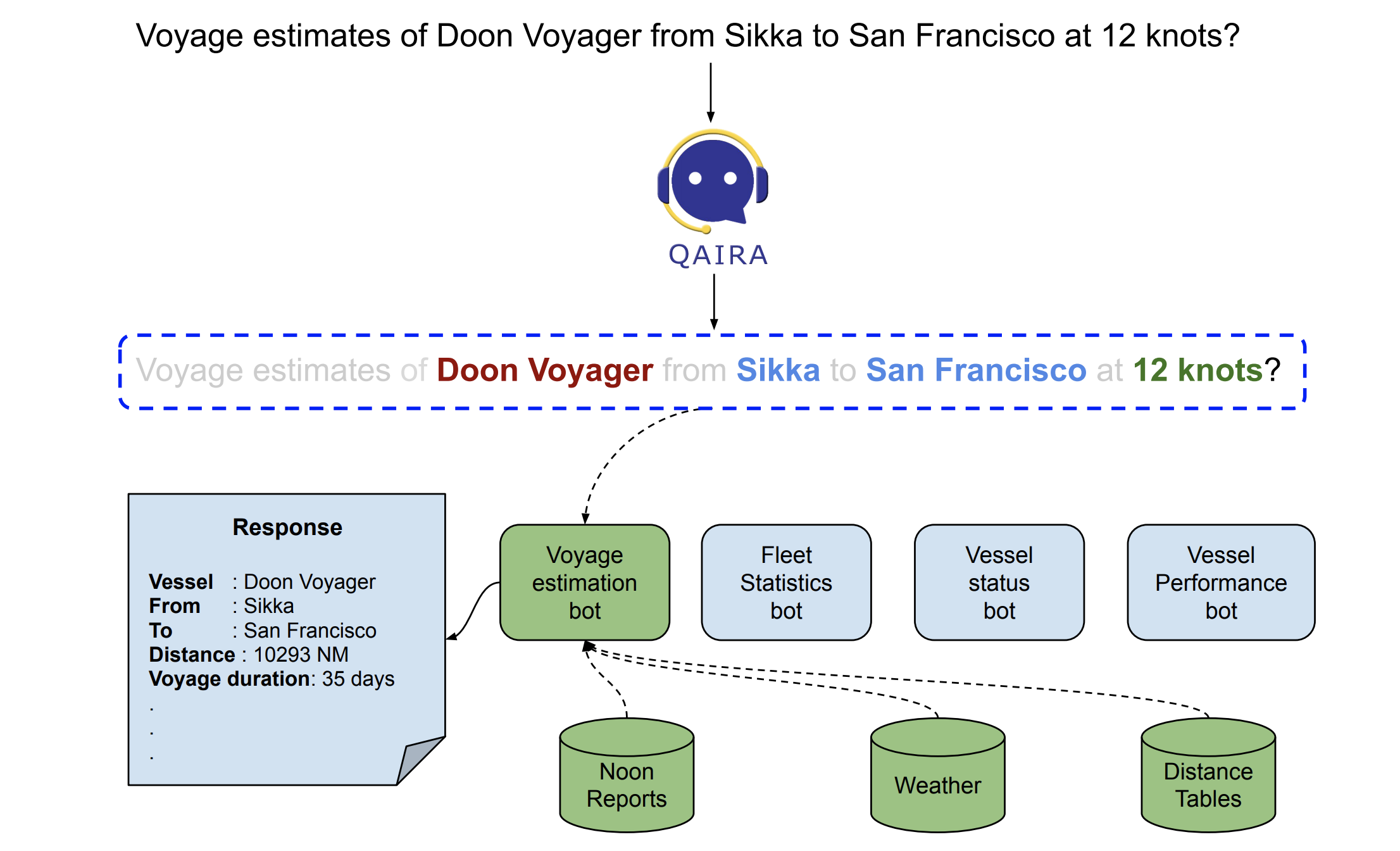
When Blue Water introduced Qaira, the goal was simple and important: make BOSS easier to use through natural language. BOSS was already digesting fleet, voyage, performance, weather, bunker, and reporting data. Qaira gave users a more direct way to reach that information without first navigating through every screen, report, and module.
Users could ask about vessel status, voyage estimates, fuel savings, performance trends, reports, bunker prices, distance tables, and fleet-level statistics. Behind the scenes, Qaira used natural language understanding to identify intent, extract entities, and route the request to the right answering engine.
It was an important first layer: BOSS became conversational. But Qaira still belonged to the pre-LLM era. It worked best when the question matched a supported pattern, while open-ended reasoning and multi-step analysis were still outside its natural scope.
Aanya: Moving From Queries to Conversations
Aanya began with a different question: what if the assistant could reason through the problem with the user? Large language models made it possible to move beyond mapping a question to a predefined intent. Aanya could interpret broader requests, decide which maritime tools were needed, generate and inspect analysis, and support follow-up questions.
In maritime operations, that distinction matters. A user may start by asking why a vessel’s consumption looks unusual, then compare it against sister vessels, narrow the time range, request a chart, or inspect a specific voyage. The answer is often discovered through interaction, not retrieved in one step.
Aanya was designed for that kind of exploration. It connected LLM reasoning with maritime tools so users could move from “find this answer” to “help me understand this situation.”
AanyaX: Moving From Conversations to Workflows
The next step is not just a smarter chat experience. It is the ability to turn recurring operational work into agents.
Aanya had already put many of the pieces in place. The agent harness architecture, maritime tool calling, BOSS integrations, and context-aware reasoning were all part of the foundation. What changed in late 2025 and early 2026 was the reliability of the underlying models. LLMs became much better at following multi-step instructions, choosing the right tools, carrying context across longer tasks, and completing complex workflows consistently.
That step change made a new product layer possible. The same ideas that made Aanya useful in a conversation could now be packaged into repeatable agents: agents that run with a defined purpose, use approved tools, produce reviewable outputs, and do the same work reliably the next time.
Maritime teams repeat the same analysis constantly. A fleet manager reviews daily status before the day begins. A performance team checks whether a vessel’s latest reports look normal. An operations team monitors checklist progress, weather exposure, route changes, reporting gaps, and exceptions that deserve attention. These are not just questions waiting to be asked. They are workflows with inputs, timing, review steps, and decisions.
AanyaX is built for that pattern. An agent can be subscribed to, scheduled, or run on demand. It can focus on one vessel or fan out across the fleet. It can gather the relevant BOSS context, call approved tools, prepare a summary, generate a live dashboard, and preserve the run history so the team can inspect what happened later.
This changes the loop. Instead of asking the same question every morning, a team can receive a prepared fleet digest. Instead of manually checking each vessel for anomalies, an agent can review the latest data and flag what deserves attention. Instead of building a static dashboard months in advance, a user can ask for a dashboard around the current operational question and let the agent assemble it from approved data sources.
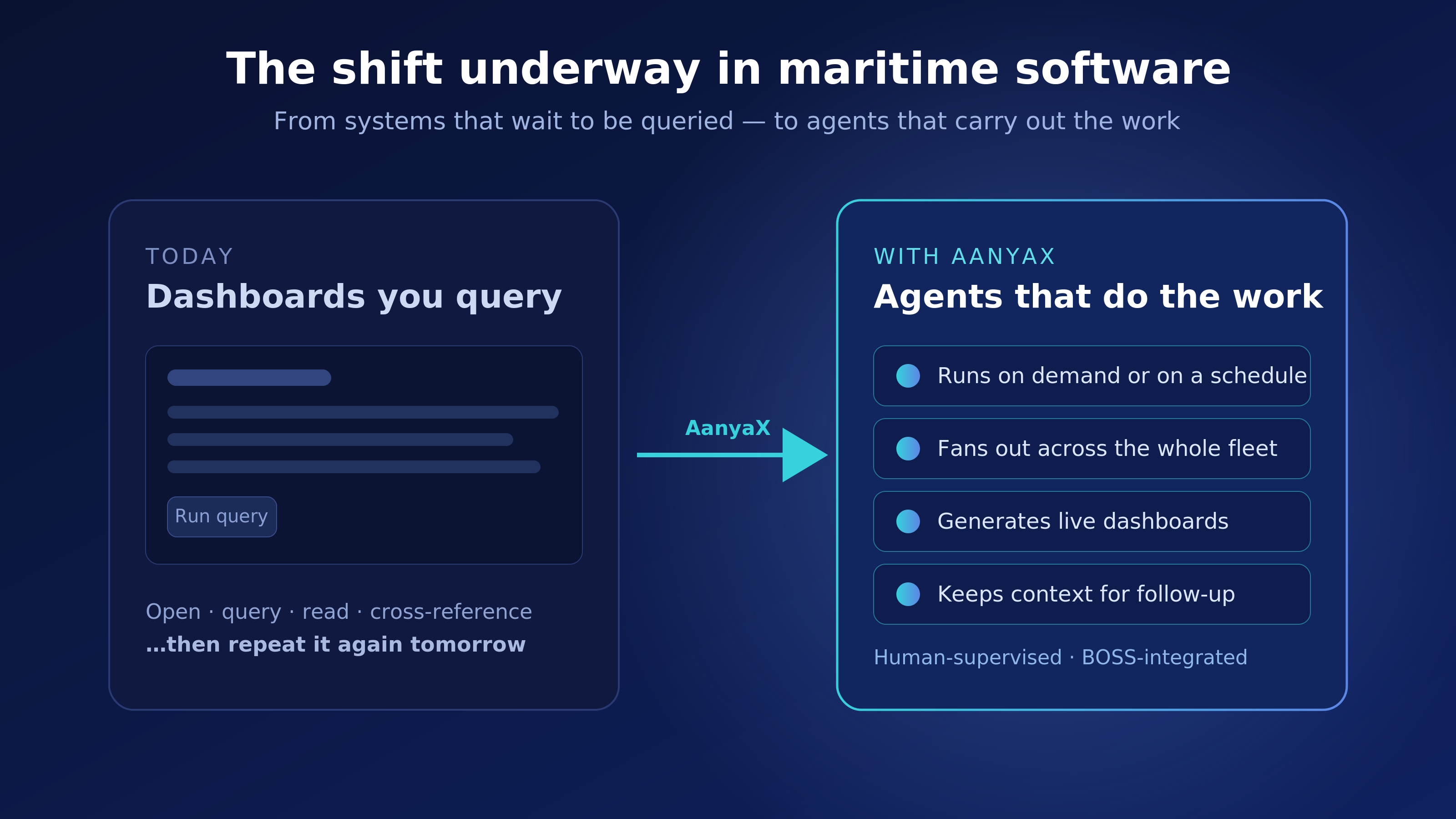
This is a different relationship with maritime software. The user is no longer responsible for remembering every recurring analysis, running every query, collecting every supporting data point, and repeating the process tomorrow. The agent can do the repeatable part. The team can review, supervise, decide, and investigate where judgment is needed.
That is why AanyaX is grounded in BOSS. The value of an agent depends on the quality of the data, workflows, and operational context it can use. BOSS provides the trusted foundation: client-scoped fleet data, voyage workflows, validated reports, monitoring signals, performance and emissions context, and authenticated access controls.
AanyaX adds the intelligence and automation layer on top of that foundation. The goal is not to replace expert review, but to make expert review faster and more consistent. Agents prepare the work, preserve the evidence, and keep the team inside the same operational system where the final judgment belongs.
The Pattern Behind the Journey
Each step in this journey expanded the role of AI in maritime software. Qaira made BOSS conversational. Aanya made it tool-aware. AanyaX makes it agent-operable.
The direction is clear: maritime AI is moving from access, to assistance, to agency. The first generation answered known questions. The second generation used tools. The next generation runs repeatable workflows under human supervision.